Service Dog Tasks and the Public Access Test, Explained
This page explains the law in general terms. It is not legal advice. For a specific situation, contact the agency listed on this site or an attorney.
Two ideas come up again and again when people talk about service dogs in Maryland: the work the dog does, and the "public access test." They are often mixed up. One is part of the legal definition. The other is a training benchmark.
This guide explains what tasks a service dog can do, how to tell a task from simple comfort, and how to use a public access test to check your own training. It follows the ADA.gov service animal guidance and the Maryland statutes. It is not legal advice.
The short answer
- Under the ADA, a service animal is a dog individually trained to do work or perform tasks for a person with a disability. The tasks must be directly related to the person's disability (ADA.gov, Frequently Asked Questions about Service Animals and the ADA).
- Comfort, companionship and emotional support alone are not tasks under the ADA.
- The public access test is a way to measure training. It is not a legal requirement under the ADA, and passing or failing it does not create or remove legal rights.
What counts as a task under the ADA
ADA.gov says the dog must be individually trained to do work or perform tasks, and that the tasks must be directly related to the handler's disability. That gives you a simple test for any behavior:
- Does the dog do something specific, on cue or in response to a trigger?
- Was the dog trained to do it?
- Does it help with a limitation caused by the person's disability?
If the answer to all three is yes, it is likely a task. If any answer is no, it probably is not.
Examples of service dog tasks by disability
These are common illustrations, not a complete list. The range of tasks is as wide as the range of disabilities. ADA.gov's service animal FAQ is the place to read the Department of Justice's own wording.
| Type of disability | Examples of trained tasks |
|---|---|
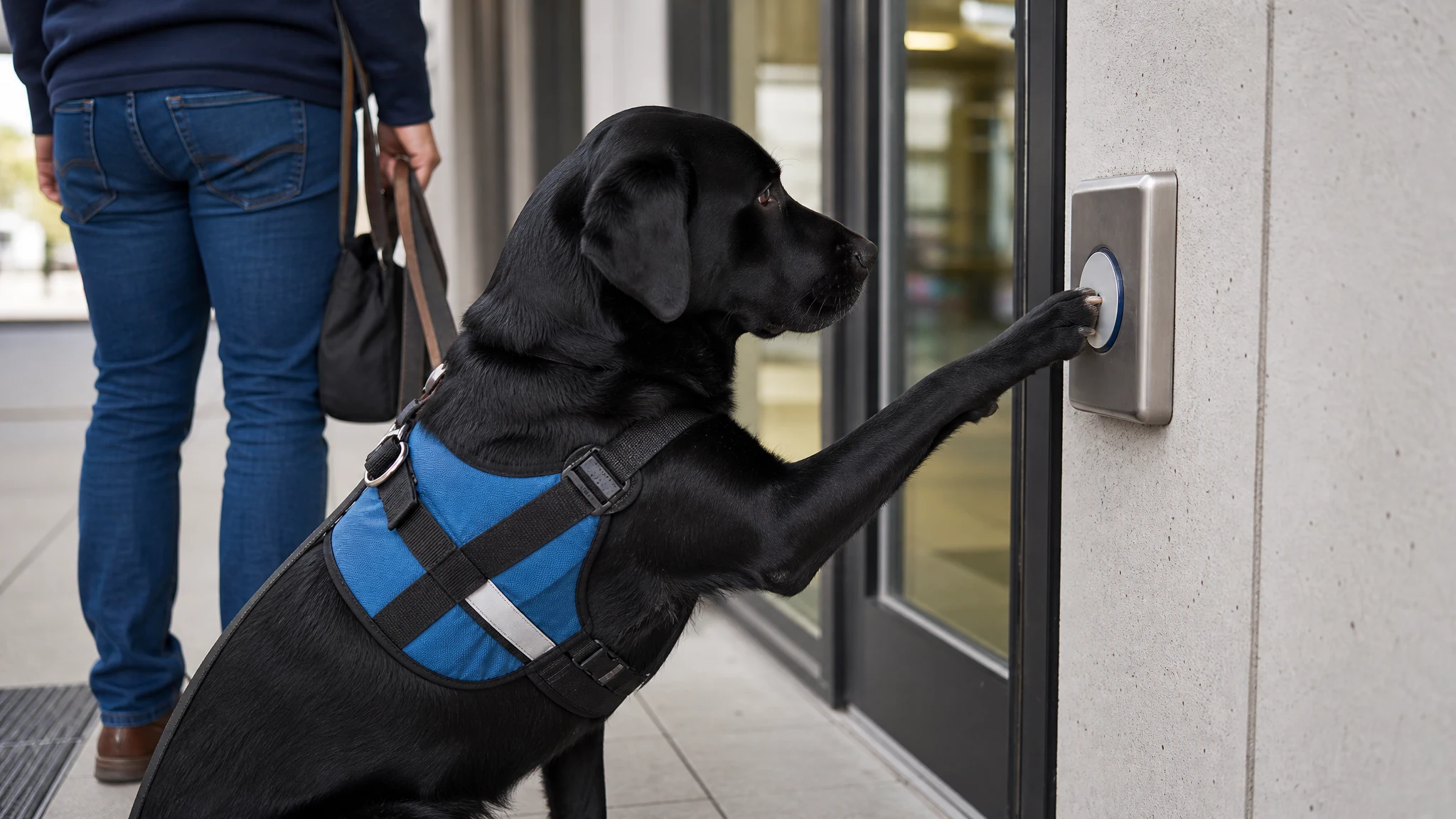
| Mobility | Retrieving dropped items, opening or closing doors, pulling a wheelchair, bracing so the person can stand |
| Hearing | Alerting to a doorbell, alarm, name being called or approaching sound |
| Vision | Guiding around obstacles, stopping at curbs and stairs |
| Seizure disorders | Responding to a seizure by staying with the person, getting help or activating an alert device |
| Psychiatric conditions, including PTSD | Interrupting repetitive or self-harming behavior, turning on lights, creating space in a crowd on cue, waking a person from a nightmare |
| Diabetes and other medical conditions | Alerting to a change the dog has been trained to detect, fetching medication or a phone |
Maryland programs describe the same range of work. For example, the Assistance Dogs International (ADI) listings for Fidos For Freedom, Inc. in Laurel, Hero Dogs, Inc. in Brookeville and Warrior Canine Connection, Inc. in Boyds mention mobility, hearing and military PTSD. Our Future Hope in Marriottsville lists sound response, seizure response and PTSD and anxiety work on its own site. Costs and waitlists are not published in the sources reviewed, so ask each organization directly.
Why comfort alone is not a task
A calming presence is real and valuable to many people. But under the ADA, a dog that provides comfort simply by being there has not been trained to perform a task. Emotional support, therapy and comfort animals are not service animals under the ADA.
A psychiatric service dog is different because the dog does something specific. A dog that has been taught to interrupt a panic-related behavior, or to wake a handler from night terrors, is performing trained work. A dog that makes its owner feel better by being nearby is not.
This distinction matters in housing too. The Maryland Commission on Civil Rights (MCCR) has published guidance saying housing providers may not adopt blanket policies rejecting emotional support animals. Check that guidance on the MCCR site for how it applies to your situation.
Maryland's definition is broader than the ADA's
The Maryland General Assembly, in Article - Human Services section 7-701, defines a service animal as a guide dog, signal dog, or other animal individually trained to do work or perform tasks for the benefit of an individual with a disability. The wording is not limited to dogs, while the ADA definition is.
Section 7-704 gives individuals with disabilities the same right as others to use roads, sidewalks, public buildings and public places, and full and equal rights on common carriers and in places of public accommodation, subject only to conditions of general application. It also says no extra charge may be made for the animal, although the handler may be liable for damage the animal causes.
For a full walk-through of access rights, training rights and where to go with questions, see our guide to service dogs in Maryland: training, access rights and where to turn.
What the public access test is, and what it is not
A public access test is a structured check of how a dog behaves in public places. Assistance dog programs, including those accredited by Assistance Dogs International (ADI), use public access testing as a training standard. The exact items, scoring and pass marks are set by ADI and by each program, so check ADI or the program you are working with for the current version.
It is a benchmark, not a law. The ADA does not require a public access test. ADA.gov says staff may ask only two questions: whether the dog is a service animal required because of a disability, and what work or task the dog has been trained to perform. Staff cannot demand a test result, a certificate or a demonstration.
There is also no official service dog registry or required certification under the ADA. A paper or online "registration" is not legal proof of anything.
So why bother with a test? Because a dog that is calm, controlled and unobtrusive is safer for you, easier to take into public places and fairer to the people around you. A business may ask a handler to remove a dog that is out of control, so reliable behavior protects your access in practice.
How to prepare for a public access test: step by step
Materials you will need
- A well-fitting flat collar or harness and a standard leash
- Small, soft treats and, if your dog likes it, a toy for rewards
- A treat pouch so rewards are quick and easy to reach
- A mat or blanket for settle practice
- A notebook or phone app to log sessions
- A helper, such as a friend or family member, for distraction practice
- Access to a range of quiet, then busier, places where you have permission to be
All training should be humane and reward-based, in line with the American Veterinary Society of Animal Behavior (AVSAB). Do not use shock, prong or choke collars, alpha rolls, scruffing or dominance methods. They add stress and can damage the working relationship.
Step 1: Write down the dog's tasks first
Before you work on public behavior, list each task your dog performs, the cue or trigger for it, and how reliably it happens. This list helps you answer the second ADA question clearly and calmly. It also keeps your training focused on work tied to your disability.
Step 2: Build a solid foundation at home
Practice sit, down, stay, come when called, loose-leash walking and a settle on a mat. Reward calm choices often. Keep sessions short, a few minutes at a time, and end on a success.
Step 3: Teach a calm, unobtrusive presence
A working dog should ignore food on the floor, other people and other animals. Practice walking past dropped treats, then reward your dog for looking at you instead. Start with easy distractions and raise the difficulty slowly.
Step 4: Practice controlled greetings and passing
Have your helper approach, speak to you and walk past. Your dog should stay beside you without pulling, jumping or sniffing the helper. Reward for staying focused. If the dog breaks position, reset and make the next try easier.
Step 5: Move to real public places in stages
Start in low-traffic settings and work toward busier ones. Look at the dog's body language: loose and relaxed is good, while pinned ears, a tucked tail, heavy panting or refusing treats are signs to leave and try an easier place next time.
In Maryland, section 7-705(c) of the Human Services Article lets a service animal trainer, professional or volunteer, be accompanied by an animal being trained in any place where a person with a disability may bring a service animal. The animal may be excluded if admitting it would create a clear danger of a disturbance or physical harm. The text reviewed did not set an age, harness or ID condition.
Step 6: Practice the settle in settings that matter
Practice a down-stay under a table, beside a chair and in a waiting area. Build the length of time gradually. A dog that settles quickly and stays settled is the heart of most public access tests.
Step 7: Rehearse common test scenarios
Use ADI or your program's published list as your guide. Typical areas include entering and leaving buildings, moving through crowds, handling noises and dropped objects, riding in vehicles and staying calm when separated from the handler at a short distance. Confirm the current requirements with ADI or your program rather than relying on memory or a general list.
Step 8: Do a mock test and take notes
Ask a helper to watch a full run-through without coaching. Log what went well and what needs work. Repeat the weak items in short sessions before trying again.
Tips for success
- Train for the dog you have. Some dogs are naturally more relaxed in crowds. Others need more time.
- Reward the behavior you want to see more of. Calm moments deserve the best treats.
- Keep your own stress low. Dogs notice tension on the leash and in your voice.
- Plan breaks. Give your dog water, a quiet space and downtime after busy outings.
- Re-check often. Public behavior can slip, so repeat refresher sessions even after the dog is working well.
Common mistakes to avoid
- Calling comfort a task. If the dog has not been trained to do a specific action, it is not a task under the ADA.
- Treating the test as a legal gate. It is a training benchmark. The ADA does not require it.
- Buying a registry or ID. No official registry or required certification exists under the ADA, and an online registration is not legal proof.
- Going too fast. Jumping straight to a crowded store often leads to setbacks.
- Using punishment. Harsh methods can cause fear and make public work less reliable.
- Ignoring the dog's stress signals. Pushing a worried dog can harm both training and welfare.
What to expect
With patient, consistent practice, many teams find that the dog becomes steadier in public and the handler feels more confident. Progress varies a lot with the dog's temperament, age, health and prior experience, and no outcome can be promised. Some dogs may do well in many settings, while others may not suit public work, and that is a valid outcome too.
Passing a test, if you take one, shows the dog met a standard on that day. It does not by itself create legal rights, and failing it does not remove the rights the law gives you.
If you are refused access in Maryland
If a business, housing provider or employer treats you unfairly because of a service animal, the Maryland Commission on Civil Rights (MCCR) handles complaints about employment, housing and public accommodations. Start at the MCCR page on how to file a complaint, or call the main line at 410-767-8600.
Under section 7-705(e), the penalties described for refusing access, such as the $500 per offense for denying admittance, are set out in the statute. Read the statute itself or ask the agency how they apply. Maryland's sources reviewed did not confirm a state ID program or a specific penalty for falsely claiming a service animal, so check with the agency if you have questions on either.
Sources
- ADA.gov, Frequently Asked Questions about Service Animals and the ADA
- Maryland General Assembly, Article - Human Services, section 7-701
- Maryland General Assembly, Article - Human Services, section 7-704
- Maryland General Assembly, Article - Human Services, section 7-705
- Maryland Commission on Civil Rights, how to file a complaint
- Maryland Commission on Civil Rights, emotional support animal guidance
- Assistance Dogs International, Maryland member search